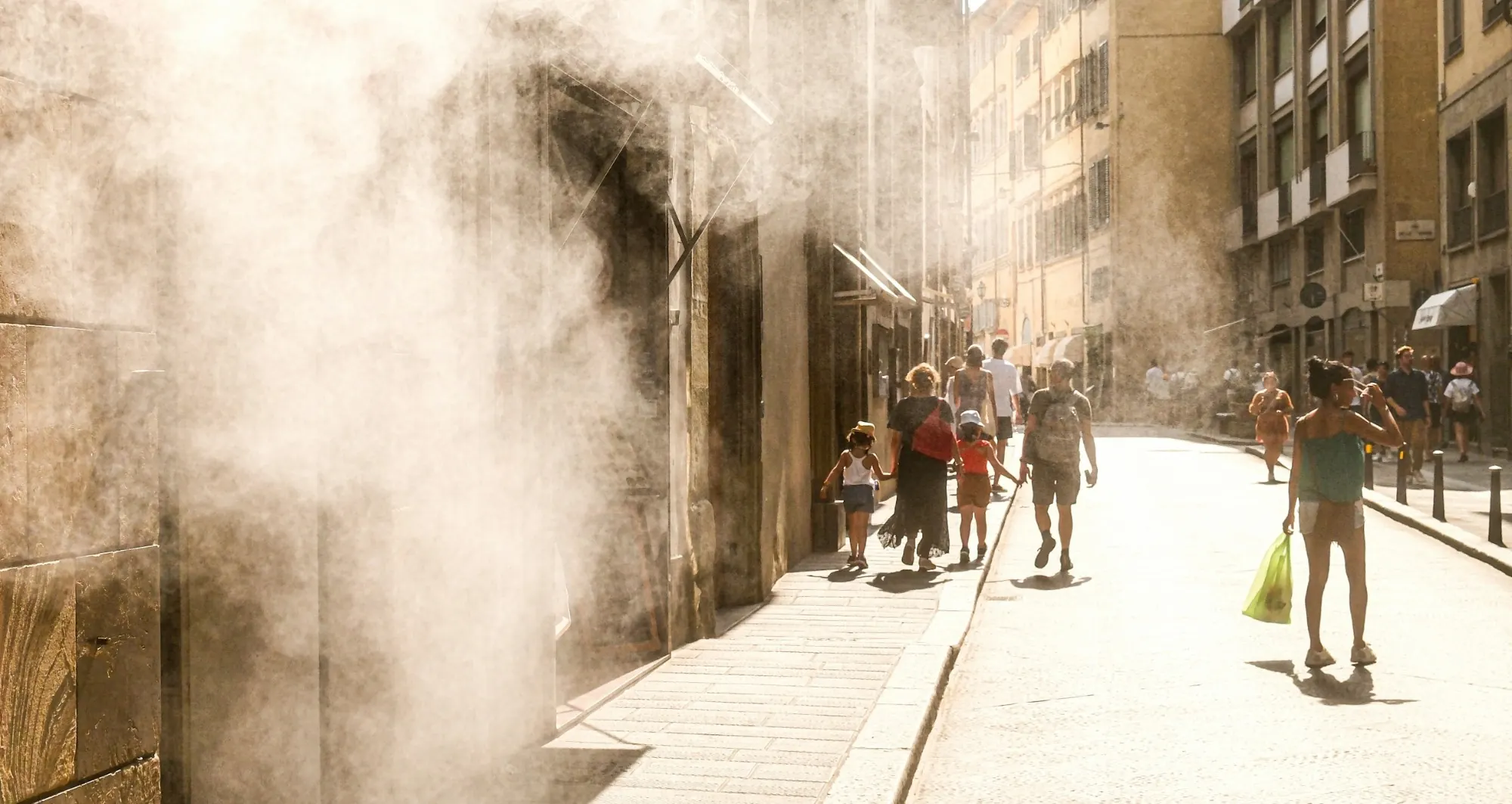
Madrid is heading towards a Estimate combining regional high-emissions temperature projections for Madrid (+5.2–5.5°C rise in P95 max temperature by 2041–2070, vs. the 1971–2000 baseline; Kotz et al. 2024, AEMET) with the added local effect of the urban heat island (+2–5°C; ERA5/CMIP6). future
Heat challenge
Rising temperatures put the city's future liveability and prosperity at risk. Extreme heat cascades through the city: from stressed infrastructure to whole-sector failures to social and economic disruption.
Heat, mapped
Where Madrid holds its heat, against where it holds its green. Drag the divider to compare.
CoolerHotter
Green areas
Ayuntamiento de Madrid: Mapa de Isla de Calor Urbano 2024; Estratos vegetales, primavera 2025.
87days/yr
Days per year hotter than Madrid's historical extremes, projected by 2050 (SSP5-8.5)
Source: AdapteCCa (AEMET) regional climate model ensemble — visor.adaptecca.es
~65 → 94
Tropical nights (>20°C) per year in Madrid, projected by 2050. Roughly two to three months a year where the body cannot cool overnight.
Source: AdapteCCa (AEMET) regional climate model ensemble — visor.adaptecca.es
3.5M+
Residents to keep safe, in a region adding roughly 1 million more people over the next 15 years
Source: Comunidad de Madrid open data — gestiona.comunidad.madrid
−16.4%
Projected loss in GDP per capita for the Community of Madrid by 2050, from extreme heat alone
Source: AXA Climate — Madrid roadshow presentation
Cascading Risks
Heat doesn't stay in one place. It cascades.
Unlike a storm or a flood, which strikes once and passes, heat in Madrid is constant and self-reinforcing: it doesn't just arrive, it builds. A single hot day moves through the physical environment, into infrastructure, into hospitals and supply chains, into the economy and the social fabric of the city. Understanding how it moves is the first step to breaking the chain.
Hover a ripple, or a level, to see where it sits in the chain.
Level 1: Root drivers & amplifiers
The underlying climate and urban conditions that set Madrid's baseline temperature and intensify local feedback.
- Madrid's landlocked, high-altitude geography already runs hotter than coastal cities at the same latitude.
- The urban heat island then adds several more degrees at night.
- Episodes of hot air pushing north from the Sahara, once rare, now recur several times each summer.
Level 2: Primary physical hazards
Root drivers translate into measurable, dangerous events.
Heatwaves, extended runs of tropical nights, and increasingly, heat arriving on top of drought: dry soil intensifies daytime highs, so a heatwave after a dry spell hits harder than the same temperatures would on their own.
Level 3: Direct, sector-specific stressors
Hazards hit the systems Madrid depends on.
Grid transformers overheat and get automatically de-rated to protect themselves, cutting available capacity right as air-conditioning demand peaks. Rail lines get speed restrictions when tracks overheat. Hospitals see admission surges tied to heat stress.
Level 4: Compound & cross-sector effects
Stressors don't stay contained. They combine across sectors.
A substation failure during a heatwave doesn't just cut power. In a modelled scenario, it also took down the water pumps feeding a hospital's cooling system, forcing an ICU evacuation — turning an electrical fault into a medical emergency.
Level 5: Long-term societal effects and feedback loops
Over time, repeated shocks entrench the very vulnerability that caused them.
As extreme heat recurs, insurers pull back cover in the highest-exposure areas, cooling costs eat further into low-income household budgets, and some residents relocate — each of which weakens the city's capacity to respond to the next event.
Values at Risk
A rise of a few degrees moves through insurance books, hospital wards, grid transformers, school classrooms, and water pipes. Each sector absorbs a piece of the same risk, mostly in isolation and our approach has been to make that risk legible.
Behind this view we are building an economic model. For each sector, we trace exposure and cost using an impact chain approach: how a hazard interacts with what's exposed and how vulnerable it is to produce a real-world impact, in line with Spain's national climate risk assessment1 and international climate-risk guidance.2
Notes
- 1 ERICC (Evaluación del Riesgo de Cambio Climático), Spain's national climate risk assessment, coordinated by IH Cantabria, Tecnalia and BC3 for the Ministry for Ecological Transition (MITECO), 2025.
- 2 Structured in line with the IPCC Sixth Assessment Report (AR6, Working Group II) risk framework and the TCFD's approach to climate-related financial disclosure.
SourcesUp to 68,000 additional heat-related deaths in Madrid by 2050, potentially fewer than 5,000 with adaptation: AXA Climate, Madrid climate-risk assessment, drawing on Masselot et al. (2024). Scenario-based estimate.622 heat-attributable deaths in the Community of Madrid, summer 2025; 84% of Spain’s heat-attributable deaths among people over 74: Instituto de Salud Carlos III (ISCIII), MoMo, 2025. momo.isciii.es ↗6.9 additional hospital admissions and 8.1 additional emergency visits per 100,000 people a month at the hottest temperatures: OECD (2025), How are hot temperatures impacting health outcomes, health systems and health systems costs?
additional heat-related deaths in Madrid by 2050 without further adaptation, falling to fewer than 5,000 with effective adaptation.
(AXA Climate / Masselot et al. 2024)
Extreme heat threatens both how long and how well people live. In the Community of Madrid, 622 deaths were attributed to high temperatures during summer 2025. Heat also increases demand for medical care: across Spain, the hottest temperatures are associated with an estimated 6.9 additional hospital admissions and 8.1 additional emergency visits per 100,000 people each month.
The burden is highly uneven: 84% of Spain’s heat-attributable deaths in summer 2025 were among people over 74. Existing health conditions increase vulnerability further, while exposure and the ability to cope are shaped by factors including working conditions, housing and access to cooling.
